
Questioning Jack Ruby: Part 2 - The Western Union Transfer Re-examined
The one fixed point in Ruby’s morning - examined against the limits of the evidence.

Jack Ruby’s visit to the Western Union office at 2034 Main Street - just over a hundred feet from where Lee Harvey Oswald’s transfer could have gotten underway at any moment at City Hall, remains a pivotal ‘timestamped’ event that aligns with how he came to be in position in the basement as Oswald’s shooter.
In fact, it’s yet another aspect of events in Dallas across the weekend of November 22nd 1963 that has broadly been accepted by most researchers. This is understandable given the presence of documentary evidence and statements supporting the claim that Jack Ruby went to the Western Union office to transfer money to an employee of his barely minutes before Lee Harvey Oswald’s shooting.
But how certain can we be of the timings and evidence that allegedly paved Jack Ruby’s way from his apartment that morning to the Western Union – considering the earlier conflicting sightings of him outside and in Dallas City Hall as mentioned in Part 1. Read on…
Karen Carlin’s contacts with her employer, Jack Ruby, asking for money during the evening of November 23 and the morning of November 24 remain among the most deceptively important episodes in the evidentiary architecture surrounding Ruby’s murder of Lee Harvey Oswald. What the Warren Commission ultimately presented as an emotionally compelling explanation for Ruby’s presence downtown — an impulsive nightclub owner helping a financially distressed employee — increasingly collapses under scrutiny into a narrative sustained by unstable testimony, chronological contradictions, and striking irregularities in the handling of documentary evidence.
Karen Carlin (aka ‘Little Lynn’) (maiden surname ‘Bennett') had worked for Ruby only briefly before the assassination, roughly two months according to her Warren Commission testimony, earning $120 per week as a salaried stripper at the Carousel Club. In fact, Karen reportedly sought and received an advance from Jack Ruby — $75 - merely two weeks prior to the Oswald shooting, and only two days before he next payday.
This puts her reaching out to Ruby on the weekend of 22/11 for a pay advance as something that's far from being a singular emergency. Instead, it suggests an ongoing pattern of financial instability and reliance upon interim payments.
This substantially weakens the emotional force later attached to the phone call placed by Karen to Jack Ruby on November 24. Nonetheless, the Warren Commission effectively transformed Karen’s requests that weekend into the crucial hinge upon which Ruby spontaneously decided to enter City Hall and shoot Lee Oswald.
In his own account, Jack Ruby did refer to the money transfer during his testimony before the Warren Commission, but only in a brief and compressed manner. He confirmed that he sent approximately $25 to Karen Carlin via Western Union on the morning of November 24, aligning with the Carlins on the basic fact of the transaction.
However, Ruby did not recount the broader sequence later described by Karen and Bruce Carlin. His testimony omits a failed meeting at the Carousel Club, an interim $5 payment arranged through a ‘garageman’, and the repeated calls spanning Saturday evening into Sunday morning. Instead, he presents the transfer largely as a routine errand rather than the culmination of an evolving set of requests.
This distinction is significant because much of the emotional and chronological structure later attached to the episode derives not from Ruby’s own account, but from the progressively expanded narrative supplied by the Carlins.
The story goes that on the evening of November 23, Karen and Bruce traveled from Fort Worth with another stripper, Nancy Powell (aka “Tammi True”), to Dallas expecting the Carousel Club might reopen following President Kennedy’s assassination. Finding the club closed, Karen telephoned Ruby from the Colony Club next door and, according to her testimony, Ruby reacted angrily by saying, “Don’t you have any respect for the President? Don’t you know the President is dead?”
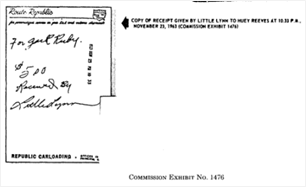
Nevertheless, Ruby arranged through parking garage attendant, Huey Reeves, to provide $5 so the Carlins could return home. See the receipt issued by Reeves to “Little Lynn” below:
Karen also testified that she mentioned needing money for rent and groceries, and Ruby instructed her to “call tomorrow.”
Her husband, Bruce Carlin’s version subtly altered the emotional texture of the encounter. He recalled personally telephoning Ruby after Karen became upset, and quoted Ruby saying, “That girl works for me, and she gets paid on a certain day.” Bruce emphasised that their immediate concern was simply obtaining enough money to get back to Fort Worth, not necessarily rent. Again, the later dramatic framing of the request appears overstated.
But the truly consequential issue concerns timing about the phone call the following morning.
Karen testified that she called Ruby at approximately “10 or 10:05 or 10:15” on Sunday morning, though she immediately conceded it “could have been” earlier. Curiously, the Warren Commission concluded that Carlin’s call to Ruby was at 10:19am. Regardless, Ruby allegedly replied to her during the call by saying that he needed time to dress, attend to his dogs, and prepare before going downtown to wire the money. Karen specifically recalled Ruby saying it would take “20 or 30 minutes” before he left.
It appears that someone within the Warren Commission, or FBI, evidently entertained the possibility that the call itself may have originated from elsewhere. Specifically, the Commission directed the FBI to investigate long-distance calls originating from Dallas Police Department phones to Fort Worth and Arlington during the precise period surrounding Oswald’s murder.
The resulting August 1964 FBI report — Commission Exhibit 2317 — focused narrowly upon calls made between 10:00pm on November 23 and November 24 itself.
The specificity of that inquiry is highly revealing. It strongly suggests investigators suspected that either Ruby or someone associated with him inside the Dallas Police Department may have contacted Karen Carlin from within City Hall itself — potentially to initiate or stage the very call later used to explain Ruby’s presence downtown.
Most strikingly, the FBI focused particular attention upon phone number RI 8-9711, described by DPD Homicide Captain Will Fritz as a general City of Dallas line accessible to prisoners and others inside the police building. According to the FBI, one of only three calls from DPD phones to Fort Worth during the relevant period originated from this number.
If the WBAP-TV accounts and Reverend Rushing’s observations are treated as accurate, then Ruby may already have been in or around City Hall prior to the alleged call from Karen Carlin. This suspicion helps explain the otherwise bizarre handling of the Carlin phone records by the FBI.
The Bureau initially compiled a detailed report covering calls from September 26 through November 21, 1963 — but stopped immediately before the assassination weekend despite the billing cycle naturally continuing beyond November 24!
Then, in April 1964, the FBI resumed reporting with sanitised records covering November 26–27 while still omitting the crucial intervening period. Finally, on September 11, 1964 — effectively too late for meaningful Warren Commission scrutiny — the Bureau produced a stripped-down report covering November 24–25 that omitted:
call times,
caller identities,
and recipient identities.
The Commission’s own confusion over the timing of Karen’s call is visible throughout the testimony. Counsel Leon Hubert repeatedly attempted to pin Karen down on the precise time. Yet in one revealing exchange, Hubert stated, “the phone records show it was about that time”.
But this assertion presents a serious contradiction. The FBI records later supplied to the Commission reportedly did not include any precise placement time for the call at all. Hubert therefore appeared to be referencing information leading the Commission to the conclusion that the Carlin call was at 10:19am that either:
did not formally exist in the documentary record,
came from undisclosed sources,
or reflected assumptions already built into the Commission’s preferred chronology.
The significance of this inconsistency cannot be overstated. If a precise timestamp actually existed, there would have been little reason for Commission counsel to spend hours seemingly pressuring Karen Carlin, George Senator, and Ruby himself to reconstruct the timing from memory. The Commission’s evident desperation to stabilise the chronology strongly suggests the documentary foundation was either absent or unreliable.
Ultimately, the Karen Carlin episode reveals something far more important than whether Ruby wired money to a financially struggling employee.
It exposes the fragility of one of the Warren Commission’s key explanatory narratives.
The official story required Karen’s call to place Ruby innocently in motion at exactly the right moment. Yet the testimony surrounding that call remained inconsistent and the supporting phone records suspiciously incomplete.
More troubling still, the investigative record itself suggests that federal authorities may have privately suspected the call was not the trigger for Ruby’s actions at all, but rather a carefully constructed alibi retroactively designed to explain them.
Fortunately, the scenario of Ruby leaving his apartment after the phone call with Karen Carlin and traveling to the Western Union seems relatively straightforward.
Having told his roommate, George Senator, that he was taking one of his dogs, Sheba, to the club, the story goes that Ruby simply drove into Dallas from his apartment in Oak Cliff and parked his car in the All State Parking lot on the corner of Main and Pearl Streets - across from the Western Union on Main. Apparently, it was the only Western Union branch open anywhere across the city on that day.
By all accounts, Jack Ruby took Sheba everywhere he went including when he left her in his car on the Friday night of that weekend when he was at City Hall and watching the Oswald press conference. And it has widely been accepted that he did the same when he drove to the Western Union on the Sunday as well. Particularly given the parking attendant, Theodore Jackson, verified as much when the police came for Ruby’s car after the shooting.
What confuses the record somewhat is that the initial report that DPD Detectives Richard Swain & Vernon Smart provided about the locating and searching of Jack Ruby’s car contained no mention of a dog. Might they have regarded a dog differently than as an item of property alongside other things that were also found such as a wallet, knuckle busters, money bags and cardboard boxes?
Either way, like in so many other instances, we know that evidence and record-keeping standards by the authorities in Dallas during and as a result of that weekend was inconsistent at best.
Ruby left Sheba in his car, with the window cracked open for air and presumably walked directly across to the Western Union office.
Western Union – Transfers in 1963
At the time, sending money through Western Union in Dallas was a straightforward but entirely manual process. A customer would visit a local office—either a standalone branch, such as the Main Street location associated with Jack Ruby, or a counter within another business—and complete a money order application form listing the recipient’s name, destination, and amount. This form could be filled out in advance or at a writing desk inside the office.
At the counter, a clerk would review the form, make any necessary corrections, and calculate the transmission fee. The sender would then pay the total amount in cash. The clerk recorded the transaction details, issued a receipt, and, upon completion, applied a time stamp indicating when the money order was officially accepted.
The completed application was then forwarded, often via pneumatic tube within the building, to a transmission department, where the details were sent over telegraph lines to the destination office. At the receiving end, the message was logged, and funds were made available for pickup, typically requiring identification from the recipient.
The entire payer interaction at the counter usually took only a minute or two, with the time stamp reflecting the moment the transaction was finalised rather than when it began.
Doyle Lane of the Western Union
In March 1964, Doyle Lane testified twice about serving Jack Ruby on November 24 - first at Ruby’s trial on March 4, and later before the Warren Commission on March 31. In July of that year, he provided an additional statement to FBI Agent Robert Barrett.
Doyle Lane consistently described his encounter with Jack Ruby as brief, routine, and limited in scope - an interaction that began not at the entrance to the Western Union office, but at the counter itself. In both his trial testimony and later before the Warren Commission, Lane made clear that he did not see Ruby enter the office. Instead, he became aware of him only as he finished serving another customer, at which point Ruby was already present at the counter.
Lane stated that he recognised Ruby from previous visits to conduct money transfers, and for that reason did not request identification. When Ruby approached him, he handed over a money order form that was already completed. While Lane initially suggested at trial that Ruby had “filled out” the form, he later clarified that he had not actually seen him write anything. His role was to review the form, make necessary corrections, calculate the transfer charges, and process the transaction. See the below copy of the form Doyle Lane said Jack Ruby handed to him:
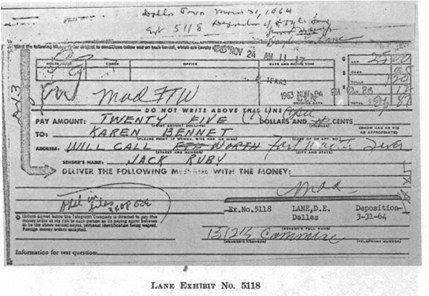
In his July statement to the FBI, Lane added further detail regarding both the sequence and duration of events. He recalled that the woman who he had been serving before Ruby could not be identified and admitted there was no way of tracing her records. As the woman left, Lane added that Ruby walked directly to the counter from the direction of the customer desks, carrying both the money order application and cash. Lane stated that Ruby, “without any comment or conversation,” handed over the form, which was then processed in the usual manner.
Lane also specified that Ruby provided $30 in cash for the $25 money order and received $3.13 in change, after which he turned and exited the office toward the Dallas Police Department. A reenactment conducted by investigators, as referenced in the same statement, placed the total time from Ruby’s approach to the counter to his exit at approximately forty-nine seconds—consistent with Lane’s own estimate that the interaction would not have exceeded forty-five to sixty seconds.
Lane also stated that he had no information regarding how long Ruby had been inside the office prior to approaching the counter, nor any knowledge of whether Ruby had interacted with other individuals before the transaction. He emphasised that the exchange itself was limited strictly to the handling of the money order and involved no additional conversation or activity beyond what was required to complete the transaction.
Analysis
Given the importance of timing and documented evidence in this case, let’s take stock of the testimonies presented in the above narrative.
The Carlins:
Karen and Bruce Carlin provided broadly consistent accounts of contacting Jack Ruby for financial assistance during the closure of the Carousel Club following President Kennedy’s assassination. Their testimony, supported in part by Nancy Powell (Tammi True), establishes that money was both requested and ultimately received. However, the underlying explanation for the transfer—and the chronology surrounding it—becomes less stable under closer examination.
Karen’s account presented the request as part of an ongoing pattern of financial dependence rather than an isolated emergency. By her own testimony, Ruby had previously advanced her money before payday, and she described the November 24 request in general terms relating to rent, groceries, and basic living expenses while the clubs remained closed. Powell’s testimony broadly corroborated this context, recalling Karen’s concern about money and the group’s lack of funds after traveling to Dallas on November 23 expecting the club to reopen.
Bruce Carlin’s account, however, gave the request a sharper sense of urgency by associating it more directly with overdue rent. Yet this explanation is weakened by his later admission that the money was not ultimately used to pay rent after November 24. Instead, portions reportedly went toward groceries, bus fare, medicine, and other general expenses. The result is a subtle but important shift: the request remains real, but the emergency later attached to it becomes less clearly defined.
The chronology of the calls introduces further uncertainty.
Karen testified that she telephoned Ruby on the morning of November 24 at approximately “10 or 10:05 or 10:15,” though she immediately conceded it could have been earlier. However, the Warren Commission had it as taking place at 10:19am. According to Karen’s account, Ruby replied that he needed time to dress, tend to his dogs, and prepare before going downtown to wire the money. This timing became critical because the Warren Commission effectively relied upon the call as the triggering event explaining Ruby’s subsequent movements.
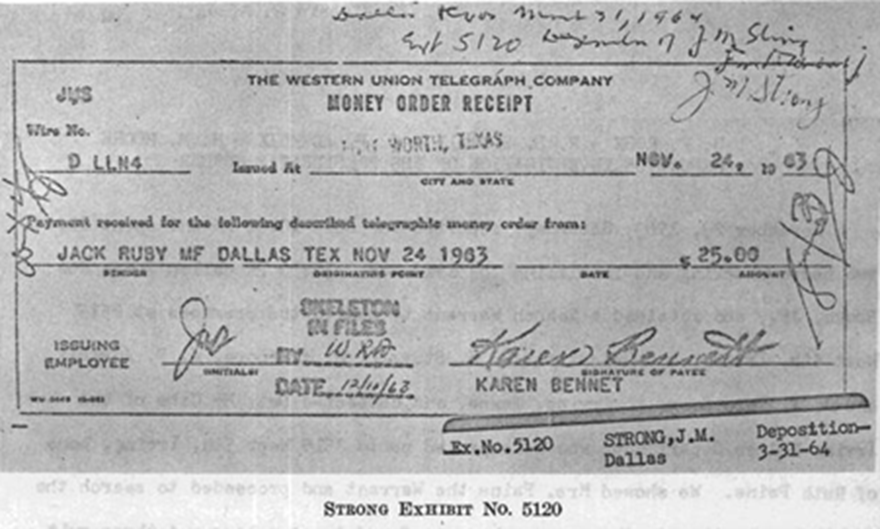
Karen and Bruce both described engaging in ordinary domestic activity after the call - eating, cleaning, dressing, and only later contacting Western Union to confirm the money had arrived. There is where evidentiary position is strongest - at the level of outcome rather than explanation. Testimony from Jesse M. Strong of the Fort Worth Western Union office confirms that the $25 transfer was in fact collected by a woman identifying herself as Karen Bennett – consistent with identification stating Karen’s maiden name - albeit incorrectly spelt at both ends of the transaction. See the receipt below:
Together, the Carlins’ accounts establish that money was requested, transmitted, and received. What remains less certain is the precise timing, urgency, and function of the request within the broader sequence of Ruby’s movements on the morning of November 24. The transaction itself is documented; the narrative attached to it is considerably more fragile.
Doyle Lane:
Back over to the Dallas Western Union office and because there was no independent confirmation, no second clerk, no search by an investigative body for the female customer, really all we can rely on is Ruby and Lane’s word and the paperwork used to transact the transfer.
And yet, even within his own account, Doyle Lane’s identification of Jack Ruby somehow only begins at the counter. He did not see Ruby enter the premises, did not know how long he had been inside, and could not account for his movements prior to their interaction. Given how small the office was, Lane’s inability to account for Ruby’s entry or prior movements remains an unsolved limitation within the evidentiary record.
Perhaps equally of significance, the physical evidence Lane processed introduces a further complication.
The money order form was already filled out when it was handed to him. Lane did not witness the man, he would come to recognise as Jack Ruby, filling it out. This is a problem because witnessing the filling out the form would bolster the evidence of it being him that walked into that office on or just prior to 11:16am and made the transfer.
However, refer to the below examples. The form on the left is the form handed to Lane by Ruby. The section pre-filled, according to Lane, therefore attributed to Ruby, is circled yellow.
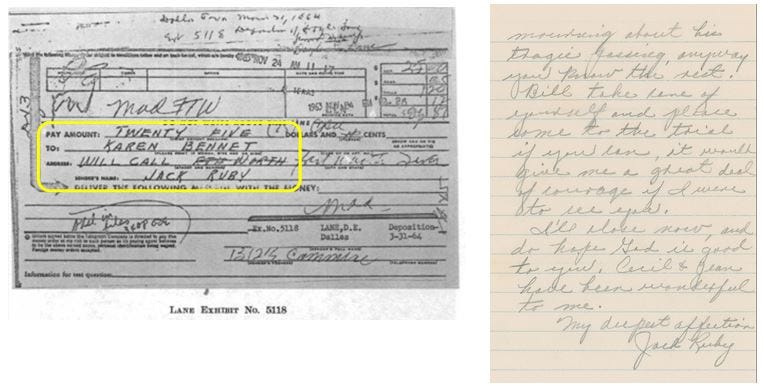
Compare it with an actual sample of Jack Ruby’s handwriting, above right, and a distinct difference in style is evident. The form shows Ruby writing in block letters whereas the sample letter he handwrote was written in cursive form. This difference in writing style cannot establish that another person completed the form, but it does underscore the limits of the available handwriting as evidence.
To be clear and in accordance with Lane’s testimonies, all other writing on the form could only have been his as he processed the transaction, such as:
in the table at the top right corner to calculate the transfer rate,
the corrected reference to Fort Worth,
marked ‘MOD’ which was the abbreviation for Money Order Department and,
the address he said Jack Ruby gave him when he asked – ‘1313 ½ Commerce’ – incidentally, the address of Ruby’s Carousel Club.
Working Hypothesis
What then, are we to make of the Western Union episode when considered against the broader evidentiary record?
At first glance, it appears to provide the strongest fixed point in Jack Ruby’s movements on the morning of November 24, 1963. A timestamped transaction exists because money was sent from Dallas and collected in Fort Worth. Doyle Lane processed a transfer in Ruby’s name, and Karen Carlin received the funds as intended.
Yet beyond those core facts, the surrounding narrative becomes markedly less stable.
The timing of Karen Carlin’s phone call to Ruby remains uncertain and dependent almost entirely upon retrospective recollection. Even Ruby’s own testimony reduced the episode to a comparatively routine transfer request, omitting much of the wider emotional and chronological context later inferred by the Carlins. Meanwhile, the FBI’s handling of the corresponding phone records was incomplete and unusually fragmented during the precise period most relevant to the Warren Commission’s reconstruction.
Doyle Lane’s identification of Ruby begins only at the counter itself, without any observation of his entry into the office, his movements beforehand, or independent verification of identity. The transfer form was already completed when presented, and the interaction lasted less than a minute.
Taken individually, none of these details necessarily undermines the transaction. Considered together, however, they complicate the degree of certainty later attached to it.
If the Western Union transfer is treated as the anchor point from which Ruby’s movements that morning are reconstructed, then the evidentiary strength of that anchor becomes critically important. Yet the record surrounding it rests on retrospective identification, incomplete documentation, and assumptions that extend beyond what was directly observed.
Perhaps one way to interpret the episode is not that the transfer itself was fabricated, but that it later became invested with greater explanatory significance than the underlying evidence can comfortably sustain. On this reading, the transaction functions less as a fully observed sequence of movement and more as a retrospective point of certainty around which the broader chronology was assembled.
This possibility becomes more significant when considered alongside the accounts explored in Part 1, where Ruby was simultaneously described as being both at his apartment in Oak Cliff and in the vicinity of City Hall during overlapping periods of the same morning. If the Western Union episode itself rests upon a narrower evidentiary foundation than often assumed, then the continuity of the broader narrative becomes increasingly difficult to stabilise.
By all means, this is not a conclusion, but a working hypothesis arising from the limits of the surviving record. The transfer unquestionably occurred. What remains less certain is whether the evidentiary chain surrounding it is sufficiently complete to support the weight it has historically been asked to bear.
Part 3 turns to the next stage of that sequence: how Jack Ruby was alleged to have entered the basement of Dallas City Hall and arrived in position to shoot Lee Harvey Oswald.