
Questioning Jack Ruby: Part 5 — Handling Ruby and Constructing the Narrative
The handling of Jack Ruby in the moments and hours after Lee Oswald’s shooting became central to the construction of the official narrative.

We turn our attention from the chaos of the scene of the Oswald shooting into the jail office – where he had just been led through only seconds prior – and to where he and his assailant were both inexplicably taken to by Dallas police personnel.
Setting aside all warranted cynicism and critical thinking about why the stricken Oswald wasn’t simply rushed to the car he was being led to and on to hospital for treatment, we can use witness accounts to indicate where Oswald (red circle) and his assailant (yellow circle) were taken to in the jail office in the below illustration:
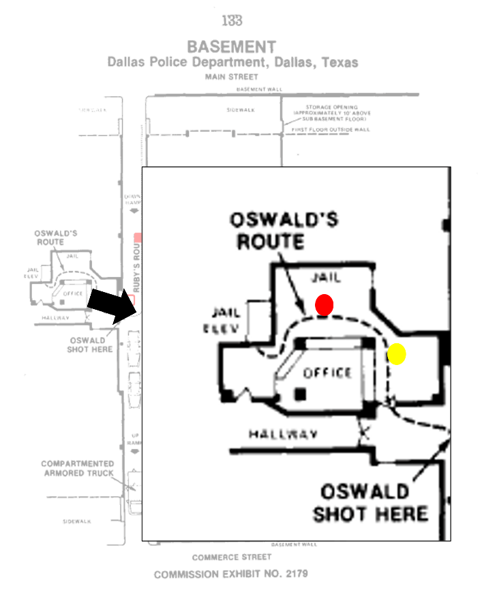
Given Oswald’s position in the jail office, we can deduce that he was brought in there first.
By all accounts, the scene inside the jail office was also chaos. A number of Dallas Police personnel were concentrated over Oswald and over his assailant. Oswald being given CPR by first aid officer, Fred Bieberdorf, is well known as is the minutes long delay in his being picked up by an ambulance and finally rushed to the nearest hospital. But for the purpose of this article, we’ll focus on the handling of Jack Ruby.
Like the shooting itself, there are differences across accounts but the general consensus was that Jack Ruby was placed on the ground face down and had handcuffs placed on him behind his back.
Either out in the basement or in the jail office, he was quoted as saying words to the effect of “What are you guys doing? I’m Jack Ruby. You know who I am.”
Within a minute or two, Ruby is picked up and escorted over to the elevator to be taken to the jail on the 5th floor.
We actually have ABC cameraman, James Davidson’s footage that shows this moment. See the below frame:
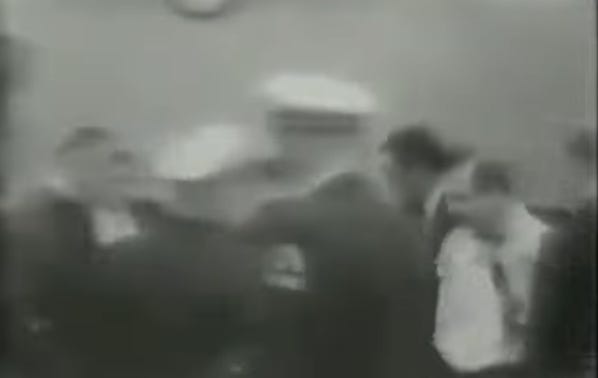
Watching this footage, it’s clear that Blackie Harrison was one of Ruby’s escorts. What’s also clear is that this footage provides perhaps the clearest visual record of Jack Ruby at the scene. Interestingly, however, Ruby is seen not wearing the suit jacket that he was described as wearing during the Oswald shooting. It appears as though his tie has been allowed to hang over his left shoulder.
The removal of clothes of a person detained for a crime is textbook police protocol – most commonly when they’ve first been brought into custody (Lee Oswald being an unfortunate and undignified exception that weekend). And depending on the circumstances of the person’s apprehension, removing articles of clothing straightaway may be a necessity.
Unfortunately, no witness accounts from the police personnel who were a part of Ruby’s initial apprehension included his jacket and tie being removed. All accounts read as though he was simply forced to the floor and had his hands cuffed behind his back with some referring to a bit of a struggle on Ruby’s part. Why was such a detail omitted by everyone who testified to the event? And why did Ruby’s jacket in particular need to be removed in those seconds after the shooting?
Like the literal covering that took place barely seconds after the shooting out in the basement, we’re left with another head-scratching question.
Before we move our focus away from the basement jail office of City Hall, we need to acknowledge a curious incident that took place outside there in the moments before and during the shooting.
Tom Howard – the Attorney at the Crime Scene
A little-known aspect of Lee Oswald’s shooting was the fact that Tom Howard, the man who would present himself as Jack Ruby’s attorney very soon after the events that morning, was actually outside the jail office in the moments prior to and during the shooting. Recorded only in statements provided for the initial Dallas Police and FBI investigations are the accounts of two Dallas police personnel and Howard himself.
Homer Lee McGee
Detective McGee described seeing Tom Howard in the basement area of Dallas City Hall immediately before Oswald emerged in the jail office to start the transfer. According to McGee’s December 5, 1963 FBI interview, he had been assigned to stand near the jail office windows awaiting Oswald’s transfer when Howard entered the area from the Harwood Street side.
McGee stated that Howard approached the jail office windows and appeared to be “looking for someone.” At approximately the same moment, Oswald was being escorted from the jail elevator through the office area and out to where the transfer procession was to begin. McGee recalled Howard then stepping away from the window and moving back toward the Harwood Street door. As Howard passed him, Howard allegedly remarked words to the effect of:
“This is all I wanted to see.”
Shortly afterward, McGee heard the gunshot that struck Oswald. He further noted that Howard was the only non-police/non-media individual he specifically recalled entering the basement area before the shooting. However, he also stated that Howard’s presence itself did not initially strike him as unusual because Howard’s office was located across from City Hall and he was a familiar local attorney frequently seen around the police building.
H. Baron Reynolds
In his statement for the Dallas Police investigation dated November 26, 1963, Detective Reynolds described his movements in the basement of Dallas City Hall immediately before and after the shooting of Lee Oswald. According to Reynolds, he had been instructed by Lieutenant Swain to help block the Commerce Street exit of the City Hall ramp in preparation for Oswald’s transfer.
Reynolds stated that at approximately 11:00am he was standing near the jail office area when Oswald was brought out from the elevator. He recalled hearing noise and confusion from the ramp area as Oswald moved into the basement transfer route. Shortly afterward, he heard a shot.
Importantly, Reynolds also described observing Tom Howard positioned near the jail office immediately before the shooting. According to Reynolds, Howard was standing behind two uniformed police officers outside the jail office area as Oswald emerged from the elevator and began moving into the basement transfer sequence.
It’s worth acknowledging at this point that both Detectives Reynolds and McGee only referred to encountering Tom Howard in one of the multiple statements they gave. Both were also on a list of witnesses to be called before the Warren Commission when it came to Dallas in March of 1964. However, neither would actually testify.
Tom Howard
Howard acknowledged being present immediately outside the jail office area at the very moment Lee Oswald’s transfer from the Dallas City Hall basement was beginning and seconds before the shooting.
According to Howard’s December 11, 1963 FBI interview, he stated that he received a telephone call on the morning of November 24 either from someone being held in the city jail or from someone calling on behalf of a prisoner. In response, he left his law office across from City Hall and entered the basement through the Harwood Street entrance.
Howard described encountering a detective stationed near the entrance whose role appeared to be monitoring access into the basement. He then walked toward the outside the jail office while awaiting transport upstairs. At that point, Howard observed a large gathering of reporters and newsmen assembled in the basement garage area and asked the detective, “Are they fixing to take him out of here?”- a likely reference to Oswald.
Howard stated that within seconds of entering the basement he witnessed sudden movement and commotion among the reporters before hearing the gunshot that struck Oswald. He claimed that he did not actually see Oswald, the escorting officers, or Jack Ruby before the shot was fired. Immediately afterward, Howard exited back out through the Harwood Street entrance and returned outside to the street.
If Detective McGee is to be believed, and Howard did tell him that he’d seen everything that he had wanted to – what did he mean?
As we follow events for the remainder of that day at City Hall, we’ll find that Tom Howard would soon become more than a peripheral figure.
One of the most important yet overlooked aspects of the 5th Floor jail episode is the chronology surrounding Jack Ruby’s alleged admissions about how he entered the basement prior to shooting Lee Oswald.
The record does not show a consistent, immediate confession by Ruby. Instead, it shows a fragmented and evolving narrative — one initially driven almost entirely by Sgt. Patrick Dean.
The first official outsider brought to Ruby after the shooting was Secret Service Agent Forrest V. Sorrels. According to Sorrels’ Warren Commission testimony, he was escorted to the 5th Floor by Dean shortly after Oswald was shot. There, in the corridor between the jail cells, Sorrels questioned Ruby in the presence of several Dallas officers including Detectives Archer, McMillion and Clardy.
Critically, when Commission counsel Leon Hubert asked Sorrels whether Ruby explained how he entered the basement, Sorrels answered that Ruby said no such thing. Sorrels’ contemporaneous notes of this encounter likewise contained no mention of Ruby describing entry via the Main Street ramp. This omission is highly significant because the route of entry was arguably the single most important unresolved issue immediately following the shooting.
Instead, Sorrels’ account portrays Ruby speaking almost entirely in emotional and sympathetic terms - grief over President Kennedy, sympathy for Jacqueline Kennedy, and anger toward Oswald. The evidentiary record therefore shows that the first documented interrogation of Ruby produced no clear explanation whatsoever of how he penetrated the basement security.
At that point, Patrick Dean became the sole outlier.
In Dean’s November 26 report for the DPD investigation, he claimed that after Sorrels concluded his questioning, Dean personally asked Ruby how he entered the basement and Ruby replied that he came down the Main Street ramp approximately three minutes before Oswald emerged.
Yet no other officer initially corroborated Dean’s claim.
Detective Archer’s first report (a handwritten affidavit) merely described escorting Ruby to the 5th Floor, removing his clothes, and remaining present during questioning. Detective Clardy’s initial statement similarly detailed the transfer and search procedure but omitted any mention of Ruby admitting entry via the ramp. McMillion’s first report likewise failed to mention such an admission.
This silence is striking. If Ruby had truly volunteered the precise manner in which he bypassed police security only minutes after the shooting, it would have represented one of the most important statements of the entire investigation. Yet Dean alone initially reported it.
Only later did the narrative consolidate.
In follow-up reports filed days afterward, Archer, Clardy and McMillion each added versions of Ruby allegedly admitting in the 5th Floor jail that he entered down the Main Street ramp and remarking that he could not have timed it any better. The progressive appearance of these details strongly suggests retroactive harmonisation rather than independent contemporaneous recollection.
The chronology becomes even more revealing when examined alongside Ruby’s later interactions.
After the 5th Floor questioning, FBI Agent C. Ray Hall continued speaking with Ruby for several hours. Hall testified that Ruby still did not clearly describe walking down the Main Street ramp. Instead, Ruby only vaguely referenced entering from the “Main Street side” and stated that the ramp was the way into the basement. This remained notably less explicit than Dean’s account.
Then came Ruby’s private consultation with attorney Tom Howard.
Hall testified that at approximately 2pm his time with Ruby was interrupted as he (Ruby) was taken downstairs to meet Howard through a screen partition. Following this meeting, Ruby’s explanations became noticeably more structured and legally orientated, particularly his repeated emphasis that the shooting arose from grief and sympathy for Mrs. Kennedy.
Could the brief reference to the Main Street ramp noted by Hall have emerged only after Ruby returned from speaking with Tom Howard?
The next and most clearly documented and unequivocal admission by Ruby that he personally came down the Main Street ramp appears during Captain Fritz’s interrogation beginning around 3:15pm.
See the below copy of Sorrel’s notes of this interrogation:
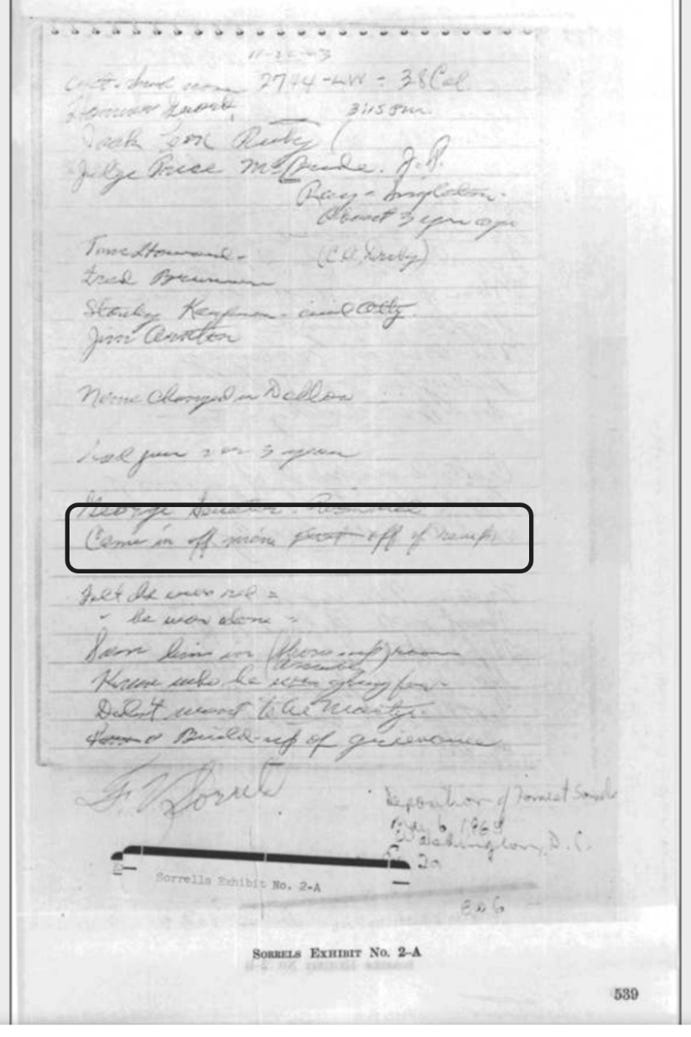
Fritz also testified that Ruby stated he entered from the outside via the ramp, though Ruby quickly became evasive once Fritz challenged the plausibility of the route.
Thus, the evidentiary sequence matters enormously.
The earliest credible record does not show Ruby spontaneously confessing how he entered the basement. It shows Sorrels explicitly denying that Ruby explained it, Dean uniquely asserting that he did, and the other detectives only later aligning themselves with Dean’s version.
Rather than a single coherent confession, the record instead suggests the gradual construction of a stabilised narrative surrounding Ruby’s entry into the basement.
The implications of this evolving narrative extended far beyond simple inconsistency.
The statements later attributed to Ruby by Dean and the other officers directly implied premeditation.
According to these later accounts, Ruby allegedly stated that he entered down the Main Street ramp only minutes before Oswald emerged and remarked that he “couldn’t have timed it better.” Dean further attributed comments to Ruby suggesting he had contemplated shooting Oswald since the Friday night press conference.
These were not neutral observations. They spoke directly to intent, planning, and malice aforethought — the precise elements that would later underpin Ruby’s conviction for murder with malice and his sentence of death at trial.
Yet critically, those claims were not firmly established in the earliest contemporaneous record.
Sorrels did not initially corroborate Ruby explaining his route of entry. Archer, Clardy and McMillon omitted such admissions from their first reports. Only later did their accounts begin aligning around Dean’s version of events.
The sequence therefore raises a serious evidentiary concern:
that highly prejudicial statements implying premeditation entered the public and investigative record before Ruby had even been formally charged and did so through a narrative that appears to have consolidated progressively rather than emerging consistently from the outset.
Whether intentional or not, the effect was profound. By the time Ruby stood trial in March 1964, the image of a man who had carefully timed and executed his entry into the basement had already become embedded within the official narrative surrounding the shooting.
Much has been speculated about Jack Ruby’s temperament across the moments, minutes and hours after the Oswald shooting. As mentioned earlier, he initially seemed surprised about being set up on by so many police personnel.
Taking Ruby up to the 5th Floor Jail, Blackie Harrison recalled to the FBI how calm he thought Ruby was. Don Ray Archer told the Warren Commission that Ruby appeared to be relieved when told that Oswald had died. Initially to the DPD, Archer also cited concern that Ruby may be a risk of harming himself. Yet, around that same afternoon, Ruby even joked with Fred Bieberdorf when he was given a rectal examination. Like Ruby’s contradictory and contrasting moods and temperaments across that weekend, we are left with a similar array to consider for the remainder of November 24 as well.
Another dimension often overlooked in assessing Ruby’s statements during the hours and days after the shooting concerns his admitted use of stimulant drugs.
During later psychiatric evaluations and court proceedings, Ruby acknowledged taking Preludin - a stimulant weight-reduction drug chemically related to amphetamines - along with other stimulants including Benzedrine-type compounds in the period surrounding Oswald’s shooting.
Contemporary reporting from June 1965 further quoted Ruby as stating he had taken “about 30 antibiotic pills and some other pills that stimulate and make you want to do positive things” shortly before shooting Oswald.
Psychiatric testimony introduced during Ruby’s later legal proceedings described him as having taken stimulant drugs regularly for weeks or months prior to the shooting. One examining physician testified that Ruby reported using Preludin continuously over an extended period and described the drug as producing pronounced stimulation effects.
Other testimony portrayed Ruby as emotionally volatile, grandiose, restless, and possessing what one psychiatrist termed “Messianic” tendencies. Ruby reportedly spoke of wanting to prove that Jews had courage following President Kennedy’s assassination and described himself in increasingly dramatic and self-sacrificial terms after the shooting.
Importantly, this does not establish that Ruby was incapable of deliberate action. Nor does it negate the possibility that he shot Oswald. However, it significantly complicates the evidentiary reliability of statements attributed to him in the immediate aftermath of the shooting.
The chronology examined throughout this section already demonstrates that Ruby’s alleged admissions regarding the Main Street ramp emerged gradually rather than consistently.
When viewed alongside evidence of heavy stimulant use, emotional instability, sleep deprivation, agitation, and suggestibility, the reliability of Ruby’s evolving explanations becomes even more difficult to assess with certainty.
This is especially significant given that some of the most prejudicial statements later attributed to Ruby - including remarks implying timing, preparation and forethought - became central to the narrative that he acted alone and with premeditation.
Rather than the calm and immediate confession later implied by portions of the official record, the available evidence may instead depict a highly agitated, stimulant-affected and psychologically unstable man whose statements evolved substantially over the hours and days following the shooting.
If Ruby’s statements during the afternoon of November 24 were shaped by agitation, exhaustion, stimulant use and repeated questioning, then the role played by intermediaries around him becomes increasingly significant. In fact, no intermediary became more influential in shaping the public understanding of Ruby’s actions than attorney Tom Howard.
As early as the afternoon of the shooting itself, Howard was already informing reporters including Jerry O’Leary and Geoff Edwards that Jack Ruby had entered the basement down the Main Street ramp. Yet the significance of Howard’s role extended well beyond public statements to the press.
FBI memoranda concerning Howard’s subsequent discussions with Captain Will Fritz show that Howard was actively relaying detailed accounts of Ruby’s alleged movements on the morning of the shooting. According to those reports, Howard told Fritz that Ruby had:
received the Karen Carlin phone call,
gone to the Western Union office,
walked up Main Street
descended the ramp into the basement,
and passed behind an officer distracted by an automobile near the entrance before entering the building.
In other words, Howard was relaying to Fritz virtually the entire sequence that would later underpin the official reconstruction of Ruby’s movements that morning - despite the fact that substantial evidentiary questions and investigative gaps surrounded each stage of that chronology.
Hence - a chronology that, as outlined throughout this series, remains marked by substantial evidentiary gaps and inconsistencies.
Critically, we must recall that this increasingly structured reconstruction of Ruby’s route emerged only after Howard had first privately consulted with him.
The chronology therefore becomes difficult to ignore. The earliest credible interrogation records do not show Ruby clearly explaining how he entered the basement. Sorrels explicitly denied that Ruby described his route of entry in the 5th Floor jail, while Dean initially stood alone in claiming that he had.
Only later did both the police narrative and Ruby’s own account begin consolidating around the Main Street ramp explanation — a process that unfolded in parallel with Howard’s direct involvement both publicly and in private discussions with Captain Fritz.
Whether viewed as ordinary legal representation, retrospective clarification, or something more consequential, Howard’s role became central to shaping the earliest coherent narrative explaining how Jack Ruby allegedly penetrated the basement security at Dallas City Hall.
Perhaps now is a good time to remind ourselves of the fact that Tom Howard was witnessed at the scene of the Oswald shooting and was content with something that he saw in the jail office in the moments prior to the event. Was there something much more significant behind this comment that has laid so low in the narrative of the shooting of Lee Harvey Oswald?
In the final part of this series, we’ll consolidate all facets of the Jack Ruby / Nov. 24 narrative to truly evaluate how firm the case was that Jack Ruby was Lee Oswald’s assassin. Having compiled the evidence and used it to highlight key questions, we’ll consider possible answers in the name of maintaining scrutiny of the official narrative.
I ‘m amazed at the lack interest in this article by the likes posted this country will never heal until the murders of JFK MLK Malcom RFK Fred Hampton are recognized as the beginning of the Nenocon movement that has literally destroyed America
Thanks Bill. I appreciate your interest. I think as long as this kind of information is out there, enough people will find it