
Questioning Jack Ruby: Part 4 - The Shooting & the Uncertainty Around It
What happened when Lee Harvey Oswald was shot appears visible but what can be confirmed is less clear.

The moments immediately preceding the shooting of Lee Harvey Oswald are often treated as settled, yet the record that underpins them remains fragmented and unresolved. Across the accounts examined thus far, no continuous, contemporaneous sequence places Jack Ruby entering the basement and moving into position.
As we saw in Part Three, those positioned outside did not reliably observe his approach; those at the ramp did not consistently agree that anyone entered; and those inside the basement only registered the presence of the shooter at the instant he acted, without immediate recognition, even among those who knew Ruby personally.
What precedes the shot, therefore, is not a clearly observed progression, but a series of partial and retrospective accounts that fail to resolve into a single, coherent narrative of movement.
It’s only fair then that we continue this level of scrutiny when it comes to the moment of Lee Oswald’s shooting.
In my book I account for 90 people in the immediate vicinity of where the shooting took place. And notably, it was a near 50/50 ratio of police to media.
Of all testimonies and statements taken, not one person testified to recognising Jack Ruby in the basement just prior to the shooting. This despite dozens of police personnel present later admitting of knowing Jack Ruby. Add to the count reporters such as Dallas-native Seth Kantor, who knew Jack Ruby for years up until that point and Ike Pappas, who would tell of the story of interacting with Ruby earlier that same weekend at City Hall.
With all that we have learned since, seeing Jack Ruby around Dallas City Hall, that weekend and prior, was no strange thing. So would it have been so bad for any of these people to have admitted seeing and recognising Jack Ruby in the basement moments before the shooting? There would have been nothing inherently unusual about such an admission. Yet no one ever made one.
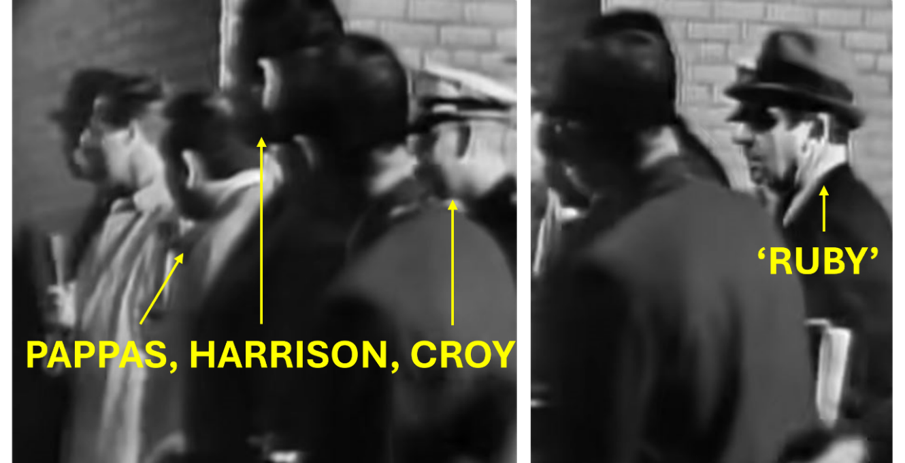
It’s all the more strange when we pinpoint that Ruby was standing amongst people who knew him before he shot Lee Oswald - including Ike Pappas, Detective Blackie Harrison, and Police Reserve Kenneth Croy. See the below frames from footage that depicts this:
Moving on and the moment of the shooting is visually clear. Captured on film, in photographs, and by nearby reporters, a man is seen to suddenly lunge forward, extend his arm, and fire. Yet the audio record of the moment is confusing - as in, statements attributed to the shooter and others.
Hearing the Shooter
There were a number of accounts from police and media personnel who attributed to either Jack Ruby or other witnesses making exclamations at the moment of the shooting. Per the below snippet of a birds eye schematic of the scene of the shooting, with Oswald signified as the circled ‘x’, these people’s positions are indicated by either numbers or initials:
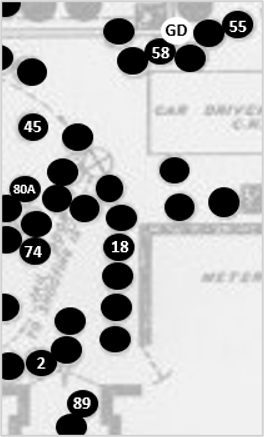
To begin with, Detective Blackie Harrison (45) told the DPD investigation, and only the DPD investigation, that he yelled “Jack!” when he saw Ruby lunge past him.
Detective Don Ray Archer (2) recalled “Son of a bitch,” later expanding it to “You son of a bitch.”
Detective Thomas McMillion (74) described a longer statement: “You rat son of a bitch. You shot the president.”
These are not variations, but fundamentally different accounts - two brief, the other structured and declarative. They do not overlap.
This inconsistency is amplified by positioning. Both men were behind Lee Oswald, with partially obstructed views, yet provide the most detailed claims.
Those in front, closer to Ruby, do not corroborate them. Instead, media personnel Seth Kantor (58) and Frank Johnston (55) recalled hearing “You S.O.B.”, was not attributed to Ruby, but to an unidentified officer.
The phrase recurs across accounts but without a fixed speaker. Detective Billy Combest (18) claimed he shouted it himself. Fellow detective, Homer B. Reynolds (89) attributed the statement to Detective James Leavelle (at Oswald's side) - who did not confirm it. And Leavelle was immediately in front of Combest that moment and he didn’t confirm hearing any such thing being said in that moment, either.
The utterance appears but its source does not.
Set against this instability is the absence of recorded sound. Reporters Ike Pappas (80A) and Gary DeLaune (GD) had tape recorders running within metres of the shooting. None captured any of the statements later described. The shot is heard but the words are not. This discrepancy is not interpretive, but evidentiary. Distinct, audible statements are described - yet no recording confirms them.
Ruby’s own later account complicates matters further. Before the Warren Commission, he stated: “I think I used the words, ‘You killed my President, you rat.” The phrasing is tentative, and its structure closely mirrors McMillion’s account - who was among the police personnel who handled Ruby up on the 5th Floor jail after the shooting.
What remains is not confirmation, but convergence without foundation: multiple accounts that resemble one another yet find no support in the contemporaneous record.
The moment is visually complete but acoustically uncertain. Ruby is seen to step forward. He is seen to fire. What he is not reliably heard to do is speak.
And in a moment so brief, so heavily documented, that absence carries weight.
Seeing the Shooter
The shooting of Lee Harvey Oswald is often described as one of the most comprehensively documented moments of the twentieth century. Six motion picture cameras and at least one still photographer captured the exact moment from multiple angles. The sequence has been replayed, analysed, and stabilised frame by frame. Ruby’s movement - his step forward, the extension of his arm, the recoil of the shot - appears, at first glance, unmistakable.
But, as with the accounts of what was said, closer examination does not produce convergence, it actually produces inconsistency.
Descriptions of the shooter’s appearance vary in ways that are difficult to reconcile with a single, fixed image. Reserve Officer Kenneth Croy, who was standing where Ruby emerged from, described Ruby’s clothing differently across his statements—recalling a dark brown hat in one account and a black hat in another. These are not minor variations of shade or tone, but distinct descriptions that reflect uncertainty at the level of direct observation.
Unfortunately, the photographic record does not resolve this because even where the figure of Oswald’s shooter is visible, questions remain.
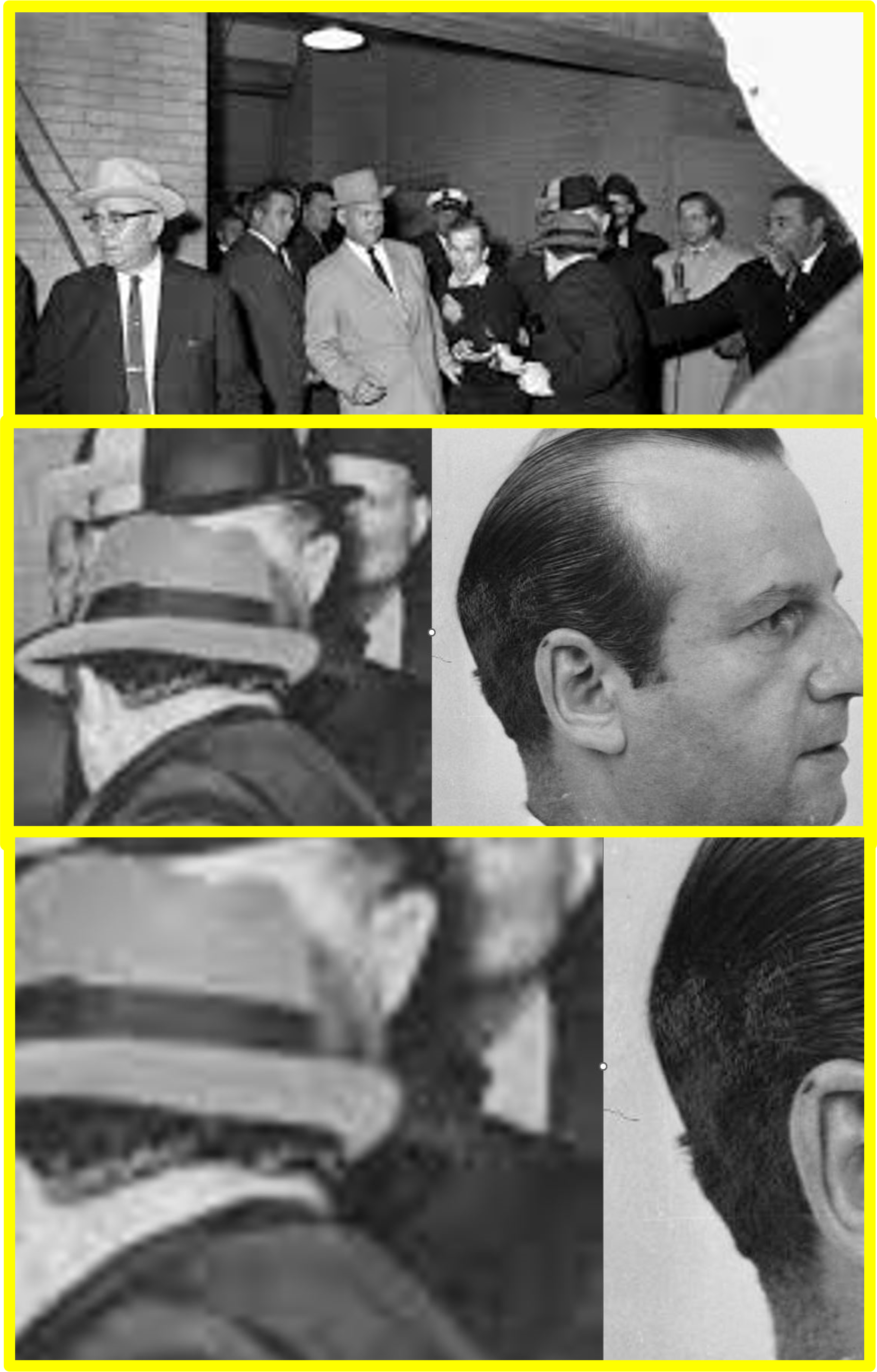
What can be seen, particularly the rear hairline at the nape of the neck, are noticeably different across the available images. The taper and contour seen in Jack Ruby’s mugshot appear to contradict the corresponding frames of Oswald’s shooter, a discrepancy that is not easily explained by angle or motion alone.
When the Jack Beers photograph is compared with enlargements of the Bob Jackson images and set alongside a profile mugshot of Ruby taken later that day, the alignment is not straightforward.
Refer to the below bank of photographs using enlargements of the Bob Jackson photograph to compare the appearance of Oswald’s shooter to a profile mugshot of Jack Ruby taken only hours later on the same day:
Below displays the same Jackson photograph segments, colourised, and alongside the Jack Beers photograph :
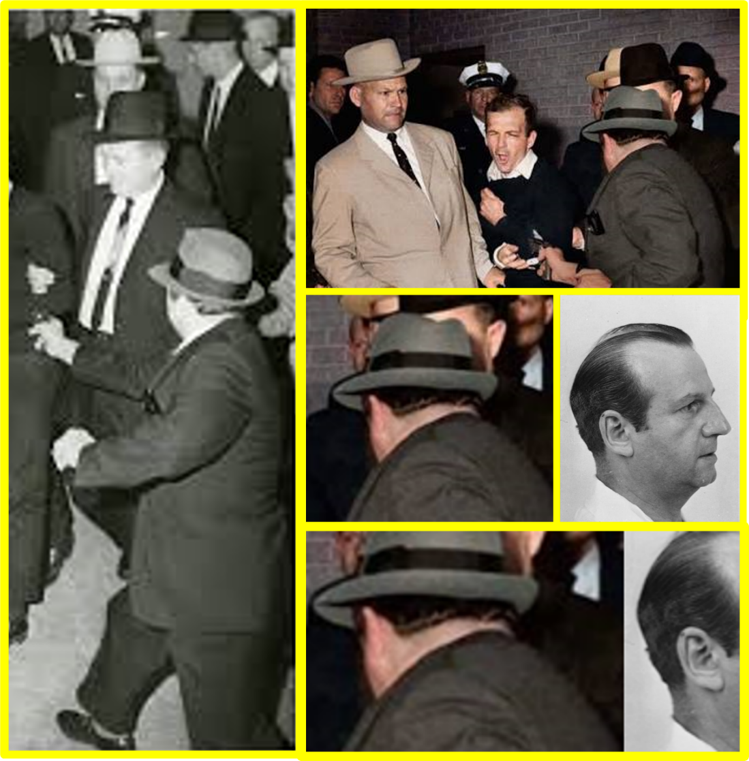
And when the image of Jack Ruby standing in wait just prior to the shooting is compared to the same mugshot of Ruby, the difference of rear neck hairlines is also clear.
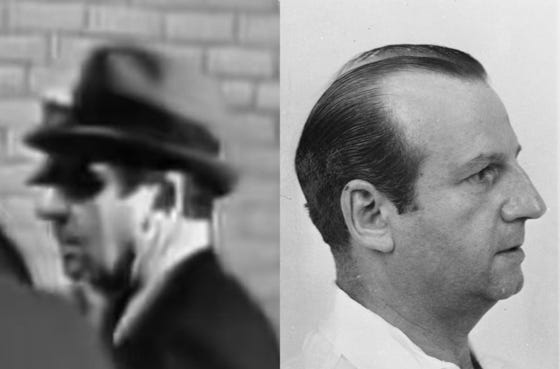
In the moment of the shooting itself, the same pattern persists. The act is visible. The sequence is captured. But the identity of the man performing it, when examined closely, is not reinforced by a single, uninterrupted visual record. Instead, it is inferred across partial views, obstructed frames, and retrospective identification.
The Physical Evidence
At first glance, the physical evidence surrounding the shooting of Lee Harvey Oswald would appear among the strongest aspects of the case against Jack Ruby. Ruby was apprehended immediately at the scene with a .38 calibre Colt Cobra revolver in his possession, while Oswald had plainly been shot in the abdomen at close range in front of police officers, reporters, photographers, and live television cameras.
Yet even here, the evidentiary record becomes unexpectedly unstable under closer examination.
One of the more remarkable findings made years later by the House Select Committee on Assassinations was that the Warren Commission did not meaningfully examine the revolver itself as forensic evidence.
According to the HSCA, the revolver recovered from Ruby at the scene by Detective L. C. Graves was never sent to the FBI Laboratory and instead remained in the possession of Dallas District Attorney Henry Wade before and after Ruby’s trial.
Following Jack Ruby’s death in 1967, the revolver was reportedly transferred to the administrator of Ruby’s estate, Jules Mayer.
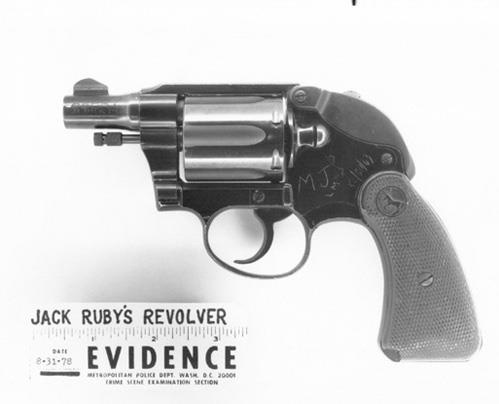
More striking still, the HSCA stated that by the late 1970s the whereabouts of both the expended cartridge case allegedly recovered from Ruby’s revolver, and the bullet removed from Lee Harvey Oswald during his autopsy, remained unknown.
According to Assistant District Attorney William Alexander, both items had been introduced into evidence during Ruby’s 1964 trial. Yet subsequent efforts by investigators to locate them through the Dallas Police Department and even Jules Mayer proved unsuccessful.
This absence is difficult to dismiss lightly.
In homicide investigations during the 1950s and 1960s, physical evidence, particularly a suspected murder weapon, expended cartridge case, and recovered bullet, was regarded as among the most probative forms of evidentiary proof precisely because such items existed independently of witness memory or retrospective interpretation.
As pioneering criminalist Paul L. Kirk famously observed in his 1953 book, ‘Crime Investigation’ “Physical evidence cannot be wrong; it cannot perjure itself…”
The significance of the missing exhibits therefore extends beyond simple archival negligence. Unlike witness testimony - which may evolve, conflict, or become reconstructed after the fact - the revolver, cartridge case, and bullet represented fixed physical objects capable of independent forensic examination. Their disappearance prevented later investigators from conducting fresh ballistic testing, independently verifying chain of custody, or reassessing aspects of the shooting using evolving forensic standards.
What emerges again is a pattern already visible throughout the surviving record surrounding November 24, 1963: namely, that even some of the most important accounts and evidence, physical and documentary elements, connected to the shooting were pursued, preserved, documented, and scrutinised far less rigorously than later historical certainty tends to assume.
We now come back to the point of this series. How certain can we be that it was Jack Ruby who shot Lee Harvey Oswald?
Together with the lack of physical evidence highlighted above, we must recall that there are no credible witness accounts of seeing Ruby enter the basement, the scene of the shooting, either down the ramp from Main Street or indeed, through the outer door of the Annex Building i.e. from the direction of the Western Union office.
In terms of visual records, we only had a brief side-on profile glimpse of ‘Ruby’ as he stood waiting for Oswald to emerge and then his back as he shot Oswald.
Any possibility of identifying the man who shot Lee Oswald in the ensuing frantic seconds was dashed by the never-explained act carried out by Louis D. Miller when he literally covered over the head of shooter.
Aside from how he knew to be prepared and ready to act so quickly, why the urgency on Miller’s part to cover the shooter? Some speculate that it might have been a tactic to disorient Oswald’s attacker but this seems redundant given the shooter had been surrounded and set upon by at least 11 other police personnel. Another possibility is that the immediate concealment of the shooter inadvertently complicated later efforts to independently verify the identity of the man who fired the shot.
Some readers may part company with my analysis at this stage. But throughout this series I have attempted only to present the available evidence and test the degree of certainty later attached to it. Whether it was Jack Ruby or another individual later identified as him, I remain agnostic as I am not tethered to any outcome. In doing so, I remain open to any evidence that Ruby was Oswald’s shooter. Until then…
Working Hypothesis
So, what are we to make of the shooting itself when considered against the broader evidentiary record surrounding November 24, 1963?
At one level, the event appears uniquely fixed. Lee Harvey Oswald was shot in the basement of Dallas City Hall in front of police officers, reporters, television cameras, and live audiences across America. A man identified as Jack Ruby was immediately seized at the scene with a revolver in his possession. Few moments in modern history appear more publicly witnessed.
Yet the closer the sequence is examined, the less continuous and contemporaneous the evidentiary chain becomes.
No clear sequence reliably places Ruby entering the basement and moving into position before the shooting. Those stationed outside do not consistently observe his approach. Those positioned near the ramp do not agree that anyone entered at all. Inside the basement, the shooter is largely registered only at the instant he acts - and even then, immediate recognition is notably absent, including among individuals who personally knew Ruby.
The visual record, while extensive, is similarly incomplete. The shooting itself is captured, but not through a single uninterrupted and unobstructed sequence capable of independently resolving identity beyond dispute. Key frames remain partially obscured, while certain physical features visible in the available imagery do not align as neatly as later certainty tends to assume.
Even the physical evidence - traditionally regarded as the strongest form of forensic proof precisely because it exists independently of memory or interpretation - proves less secure than expected. The revolver itself was apparently never subjected to meaningful FBI laboratory examination during the Warren Commission investigation, while the whereabouts of both the expended cartridge case and bullet removed from Oswald later became unknown.
Taken individually, none of these issues necessarily overturns the accepted account. Considered together, however, they complicate the degree of certainty later attached to it.
On this reading, the evidentiary problem is not whether a shooting occurred, but whether the surviving record independently establishes - with the degree of continuity and verification later claimed - that the man seen firing the shot can be conclusively identified solely through the contemporaneous evidence itself.
This is not a conclusion, but a working hypothesis arising from the limits of the surviving record. What happened is visible. What remains less certain is whether the evidentiary foundation beneath the accepted identification is as complete and stable as history has long assumed.
With that, Part 5 turns to the aftermath of the shooting itself - the moment Jack Ruby was finally and unmistakably seen at the scene, and how he came to be publicly and institutionally established as the man who killed Lee Harvey Oswald.
Incredible forensic breakdown. Have you looked into the Meyer Lansky connection here? That thread runs deeper than most people realize to Ruby. I went down the rabbit whole because of the brand new totally unredacted files released last year. These were redacted every time on the previous 4 releases but this time they weren't. https://wavesandpositions.substack.com/p/we-know-who-killed-kennedy
Fascinating stuff, Paul! The missing physical evidence is a startling finding. If it's not Ruby, then it was all staged to execute Oswald, with Ruby still slotted in to take the fall.
I've certainly learned over the years that official stories can be riddled with lies and subterfuge. I will go back and read the earlier entries in the series. Thanks so much for doing this research